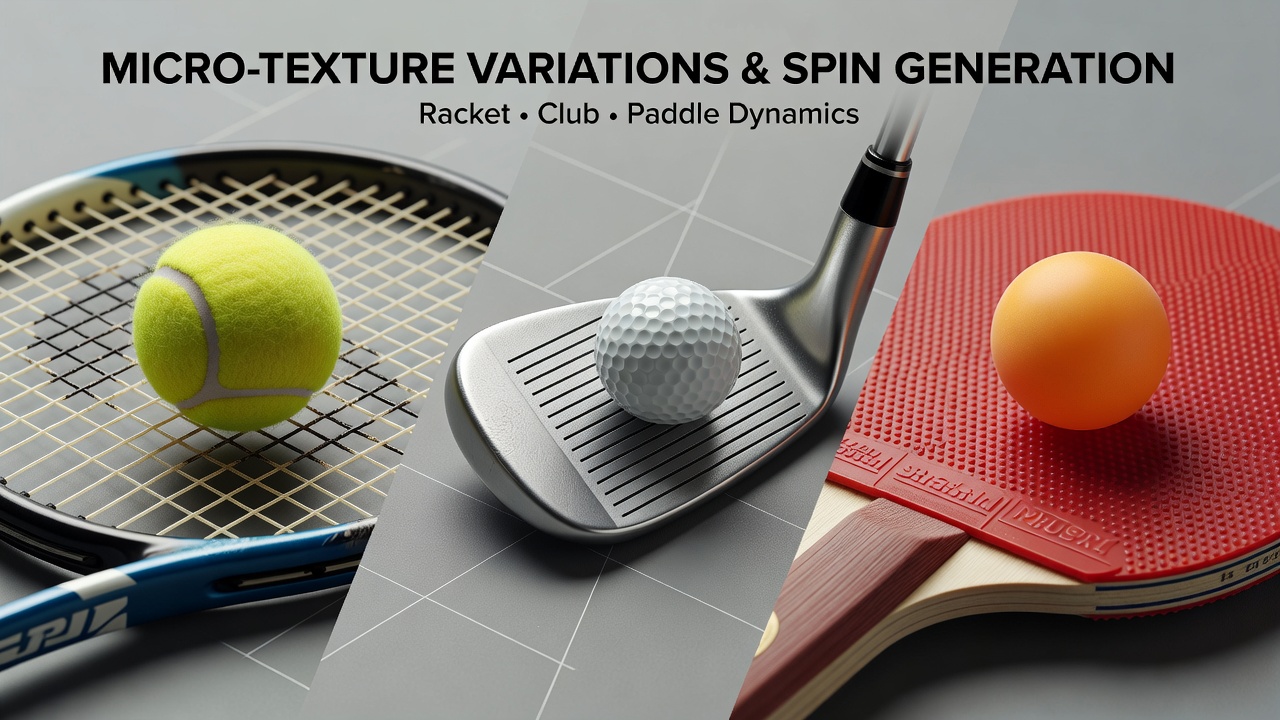
How Micro-Texture Variations on Contact Surfaces Influence Spin Generation in Racket, Club, and Paddle Based Activities
Spin generation in racket, club, and paddle sports depends heavily on the fine-scale surface features where equipment meets ball, and researchers have measured how those features alter friction and energy transfer during impact. Micro-texture refers to the patterns, roughness levels, and material distributions at scales from micrometers to millimeters, and these details change the coefficient of friction that determines how much tangential force the surface applies to the ball.
Physics Behind Texture and Spin
During contact the ball deforms slightly against the surface, and the resulting friction force creates torque that initiates rotation. Studies from the University of Queensland show that increasing peak-to-valley height within a controlled range raises the friction coefficient until a saturation point appears, after which additional roughness begins to reduce effective contact area and spin output. The relationship follows patterns described in tribology models where real contact area, rather than nominal area, governs tangential force transmission.
Observers note that directionality of texture also matters, with linear grooves aligned perpendicular to the swing path producing higher spin rates than isotropic roughness in many test conditions. Data collected across multiple sports indicate that groove spacing between 0.2 and 0.8 millimeters often maximizes spin for typical impact velocities, while wider spacing allows more ball slip before full grip occurs.
Applications Across Different Equipment
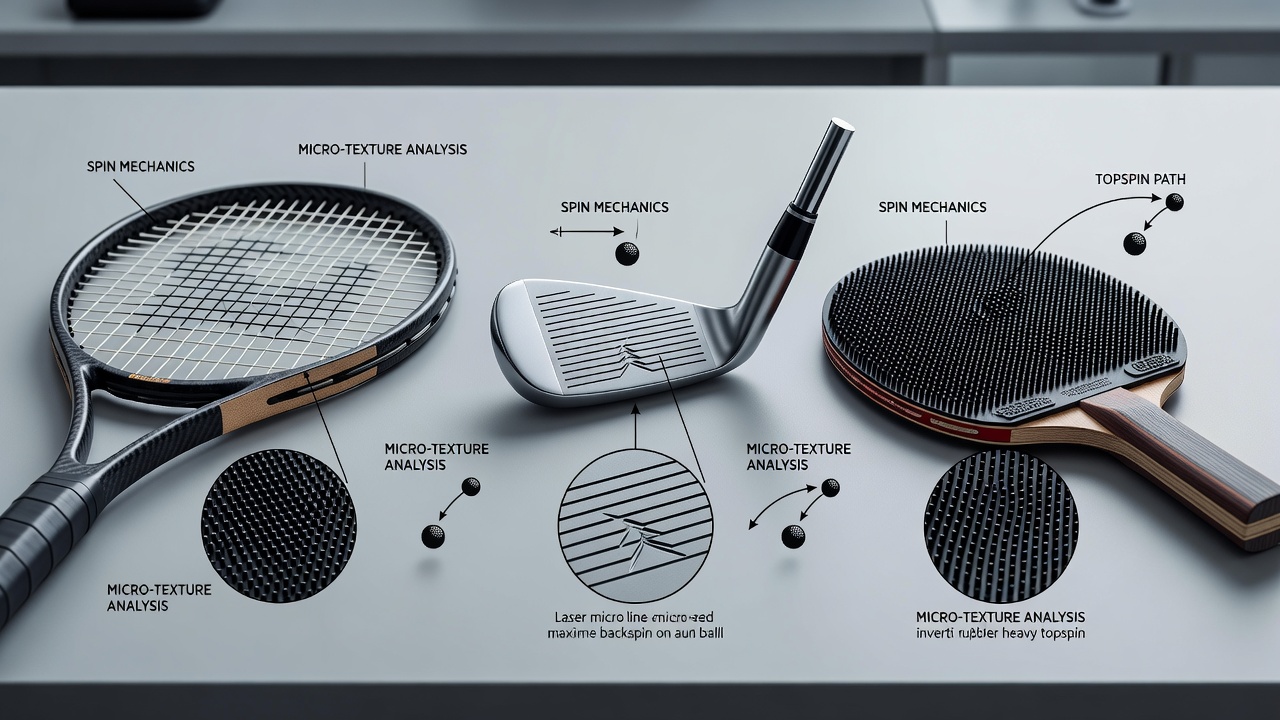
Tennis racket strings and their surface treatments provide one clear example, because modern polyester strings receive specific texturing during extrusion that creates microscopic ridges along their length. These ridges increase friction against the ball felt, and laboratory measurements report spin rates rising 15 to 25 percent compared with smooth strings of identical diameter and tension. Golf club faces follow a similar principle through controlled milling or laser etching that creates micro-grooves meeting USGA limits on edge radius and spacing, and players achieve measurable backspin increases when groove geometry stays within those regulatory boundaries.
Table tennis paddles use rubber surfaces whose pimple structures and top-sheet textures directly influence spin, and manufacturers adjust particle size in the rubber compound to tune grip without exceeding International Table Tennis Federation thickness rules. Pickleball paddles occupy an intermediate category where composite faces receive either textured coatings or machined patterns, and recent trials show that certain grit levels correlate with higher topspin on drives while maintaining control on soft shots.
Measurement Techniques and Material Choices
Equipment testing facilities rely on high-speed cameras and force sensors to quantify spin after impact, and these systems capture rotation rates at thousands of frames per second while simultaneously recording normal and tangential forces. Researchers at the National Institute of Standards and Technology have published protocols for mapping surface topography using white-light interferometry, allowing precise correlation between measured roughness parameters and observed spin outcomes across repeated trials.
Material selection further modulates texture performance because harder surfaces maintain groove definition longer under abrasive contact, whereas softer polymers can conform more during impact yet wear faster. Carbon fiber composites in paddle faces often receive thin ceramic or polymer coatings that carry the final texture, and these layered constructions allow independent optimization of stiffness and surface friction.
Developments Observed in October 2026
During October 2026 several equipment manufacturers released updated product lines featuring refined laser-textured faces on golf clubs and new rubber compounds for table tennis paddles, and independent testing confirmed incremental spin gains within existing regulatory frameworks. Industry reports from the European Sports Engineering Association documented that these incremental changes produced measurable differences in ball trajectory under controlled launch conditions, although real-world player results continued to depend on swing speed, angle, and ball condition.
Conclusion
Micro-texture variations on contact surfaces represent a critical variable in spin generation across racket, club, and paddle activities, and ongoing measurement work continues to refine understanding of how specific roughness parameters translate into performance outcomes. Equipment standards from governing bodies maintain limits on texture geometry while still permitting meaningful design choices that influence play. Those who study these interactions through controlled experiments and field data collection have established clear connections between surface features and rotational behavior, connections that guide both manufacturing decisions and competitive equipment selection.